
Angle of attack (AOA) is a fundamental concept in aviation that influences every aircraft type, from training aircraft like the Cessna 172 to large jets like the Airbus A320. Knowing what angle of attack is and how it affects aerodynamics is essential for safe flight and high performance. What does a pilot need to know? Read on!
Quick Navigation to Angle of Attack
- What is Angle of Attack?
- Aerodynamics Behind AOA
- Factors That Affect Angle of Attack
- How Pilots Monitor and Control AOA
- Alerting Pilots of a Critical Angle of Attack
- Accidents Involving Angle of Attack
- Watch Our “Angle of Attack” Video!
- Applications: From Training to Jets
- Planning and Performance
- Join the Forum Discussion on Angle of Attack!
What is Angle of Attack?
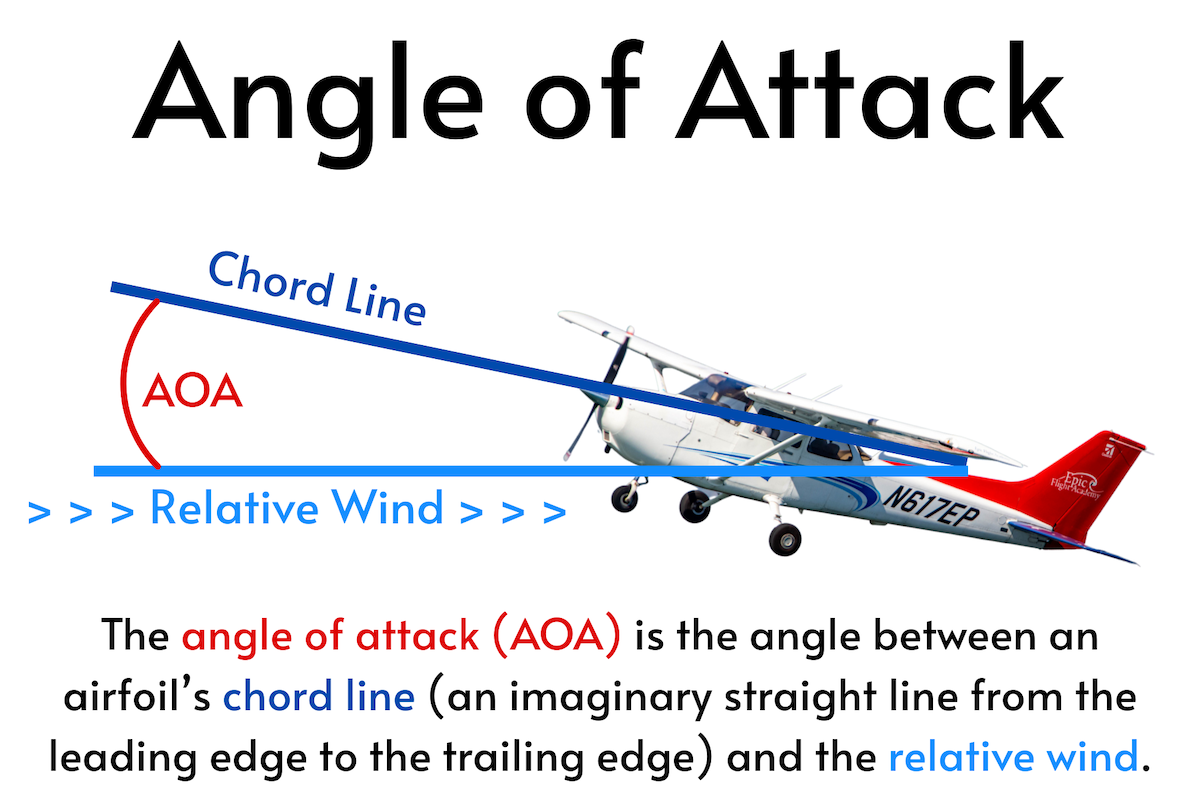
By definition, angle of attack is the angle between an airfoil’s chord line (an imaginary straight line from the leading edge to the trailing edge) and the relative wind (the airflow opposite the flight path). Pilots constantly manage this angle with the airplane’s controls, using pitch and attitude changes to maintain lift and stability.

The AOA can be positive, negative, or zero, depending on the airplane’s position and incidence relative to the airflow. Understanding normal vs inverted flight attitudes helps pilots find the critical balance between lift and drag. Relative wind is the air moving past the wing, flowing in the opposite direction as the airplane’s flight path.
Angle of attack can be written several ways:
- Angle of attack
- AOA
- Alpha
- a
Simply put, AOA is a simple concept that is a bit more complex in practice.
Aerodynamics Behind AOA
AOA affects these key aerodynamics concepts:
- Lift and Drag: Increasing AOA increases lift, up to a point. Beyond the critical angle, flow separation occurs, lift drops, and a stall happens.
- Center of Pressure: As AOA changes, this point on the airfoil shifts, altering moments and stability.
- Boundary Layer and Downwash: The thin layer of air hugging the wing and the downward airflow behind it influence induced drag and wingtip vortices. Vortex formation is closely related to AOA. The way air flows over and around the wing changes the AOA, and vortices are a byproduct of that airflow behavior.
- Lift-to-Drag Ratio and Glide Ratio: Pilots use these measurements to plan energy-efficient descents or emergency glides.

Equations and formulas, including the lift coefficient, quantify these effects, while graphs help visualize how lift changes with different angles.
Factors That Affect Angle of Attack
Several key factors influence angle of attack (AOA) during flight. Changes in these factors increase or decrease the angle:
1. Aircraft Attitude and Pilot Control
- Pitch inputs with the yoke or stick raise or lower the nose, changing the wing’s angle to the airflow.
- Using flaps, elevators, or tailplane trim alters wing camber and the effective chord line, which can increase or reduce the AOA for a given pitch.
2. Airspeed and Flight Path
- Slower airspeed requires a higher AOA to maintain the same lift, while higher speed lets the wing produce lift at a lower angle.
- Climbing, descending, or performing a steep or shallow maneuver also changes the relative wind, affecting AOA.
3. Weight and Load Factor
- Heavier weight or higher load factor (for example, in turns) requires more lift, which the pilot achieves by increasing AOA.
- Wing contaminants, such as dirt and bird waste, don’t affect the weight per se, but it can affect AOA. A clean plane is best.
4. Wind and Atmospheric Conditions
- Wind gusts or turbulence can suddenly shift the relative wind, increasing or decreasing AOA.
- Density altitude (affected by temperature, pressure, and humidity) changes how much AOA is needed to generate the required lift.
- Icing is especially problematic, because the AOA becomes unpredictable in this situation.
5. Aircraft Design
- Wing shape (camber), wing incidence (the built-in angle between the wing and fuselage), and use of flaps or leading-edge devices determine how readily a given AOA creates lift.
- Different airfoil or propeller/jet engine thrust lines can influence the relationship between pitch attitude and actual AOA.
How Pilots Monitor and Control AOA
Modern airplanes may include an angle of attack indicator or sensor to help pilots find safe margins. In a commercial aircraft, for example, these instruments feed data to flight displays and flight control systems. Pilots also rely on visual cues, airspeed, and attitude to manage AOA during every maneuver, from takeoff to steep or shallow approaches.
Flaps and tailplane trim allow precise changes to the airfoil shape and camber, altering the AOA required for lift. Propeller or jet thrust, as well as turbine or blade performance, interact with the AOA to keep the airplane flying safely.

Alerting Pilots of a Critical Angle of Attack
Most aircraft use stall warning systems to alert pilots before reaching the critical angle of attack. If an airplane lacks built-in warnings, pilots must depend on AOA indicators or heightened situational awareness to stay safely below that limit.
Typical warning signs of an impending stall include:
- Buffeting (vibrations felt through the controls or airframe)
- Stall horn or warning tone
- Mushy or unresponsive controls

“The most common angle of attack (AOA) mistakes pilots are most likely to make include a lack of awareness of its role in every flight phase, letting the wing exceed the critical AOA and stall, and using ailerons or back-pressure incorrectly during stall recovery, which can worsen the problem or cause loss of control. Many pilots also think stalls come from low airspeed, when the real cause is exceeding the critical AOA.” –Ray Altmann, Chief Flight Instructor, Epic Flight Academy
Accidents Involving Angle of Attack
The most famous accidents involving AOA are the Boeing 737 Max crashes. Both Lion Air Flight 610 and Ethiopian Airlines Flight 302 experienced deadly crashes linked to malfunctioning AOA sensors, which sent incorrect data to the MCAS software. As a result, pilots experienced all loss of control.
Watch Our “Angle of Attack” Video!
Applications: From Training to Jets
- Flight Training: Student pilots here at Epic learn to define and compute AOA. They may use a calculator or digital instrument that can find critical values. Online calculators are also available.
- General and Commercial Aviation: Whether flying a light trainer or a jet, pilots use the same principles to plan climbs, descents, and energy management.
- Special Aircraft: From gliders that maximize glide ratio to supersonic jets where compressibility effects dominate, every design must account for AOA.
Planning and Performance
AOA knowledge supports flight plans, helps pilots find the right formula or equation for performance calculations, and lets them compare versus speeds and conditions for normal vs inverted flight. Whether adjusting flaps for a steep climb or checking a performance graph, understanding AOA is critical to safe operations.
From experimental aircraft to the commercial airliners, angle of attack is central to aviation safety and efficiency. Knowing how to measure it, predict its effects, and maintain it within safe limits keeps wings producing lift and keeps every flight, from training flights to high-speed maneuvers, under control.
Join the Forum Discussion on Angle of Attack!
Disclaimer: Epic Aviation, Inc. does not verify, endorse, or approve any reviews, complaints, housing listings, or other public content. All content is provided "as is," without inspection or warranty. We do not screen users or listings and assume no responsibility for any communication, meeting, or transaction. Use is at your own risk. Use of this site constitutes acceptance of our Privacy Policy and Terms of Service.


