
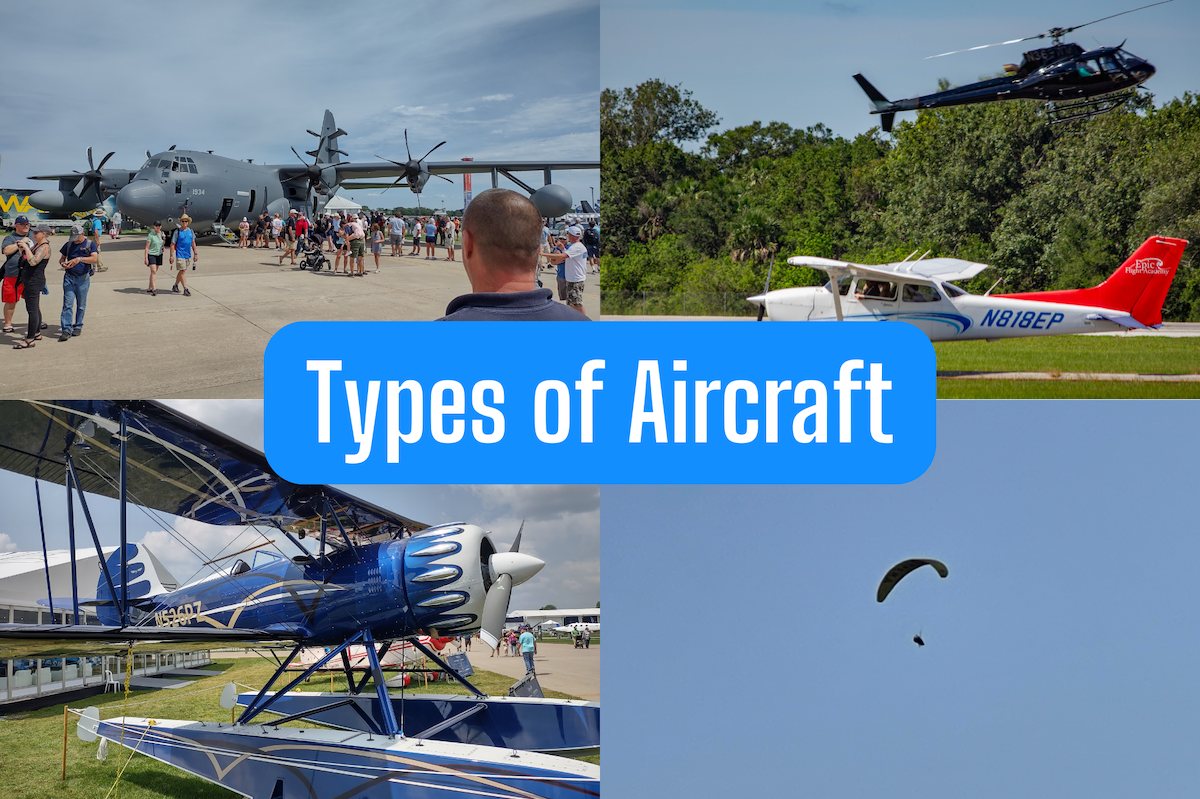
Aviation is filled with a wide variety of aircraft with each designed for a specific purpose. Whether you fly as a passenger on a commercial aircraft, study military models like stealth aircraft, or admire a balloon drifting over the countryside, every type of aircraft contributes to the story of flight.
Quick Navigation to Types of Aircraft
- Categories of Aircraft
- Civil and Commercial Aircraft
- Military Aircraft
- Special-Purpose Aircraft
- Lighter-Than-Air Aircraft
- Rotorcraft and Powered-Lift
- Power and Performance in Types of Aircraft
- Watch our Video on Types of Aircraft
- Types of Pilot Requirements by Types of Aircraft
- Civil Aircraft Pilot Requirements
- Military Aircraft Pilot Requirements
- Special-Purpose Aircraft Pilot Requirements
- Lighter-Than-Air Pilot Requirements
- Rotorcraft & Powered-Lift Pilot Requirements
- Join the Forum Discussion on Aircraft Type Below!
Categories of Aircraft
Aircraft can be grouped into broad categories and then subdivided into more specific types. The most common distinction is between civil aircraft and military aircraft:
Civil Aircraft include private jets, commuter aircraft, regional jets, cargo aircraft, general aviation, which includes flight training, air taxi services, light-sport aircraft (LSA) and ultralight airplanes. The most common would be full-service carriers like American Airlines.
Military Aircraft include bombers, fighter jets, stealth aircraft, transport planes, trainers, and warbirds (vintage combat aircraft).

Another way to classify aircraft is by design category:
Fixed-Wing Aircraft (airplanes)
Rotorcraft (helicopters, gyrocopters, and autogyros)
Gliders and Powered-Lift Aircraft (hang gliders, motor gliders, electric vertical takeoff and landing – eVTOL)
Lighter-Than-Air (airships, balloons, blimps)

Each category uses a different way of achieving flight, such as wings, propellers, jets, or lighter-than-air gases. Although aircraft can be further categorized in all sorts of ways, such as the biggest, fastest, and highest-flying, I’ve broken it down into five general categories. Read on to learn about civil and commercial, military, special-purpose, lighter-than-air, and rotorcraft.
Civil and Commercial Aircraft
Commercial aircraft carry millions of passengers daily. Famous models include the Concorde, a supersonic aircraft that once flew faster than the speed of sound, and today’s efficient turboprops and jets used by airlines. Flight schools like Epic train pilots to fly for the airlines.

Regional jets and commuter aircraft serve shorter routes, while air taxi services fly passengers point-to-point on smaller planes. Cargo aircraft are designed to transport goods instead of people. Private jets allow individuals and companies to fly on their own schedule, while light-sport aircraft (LSA) and ultralight airplanes provide recreational pilots with affordable ways to fly.
Military Aircraft
The military sector operates a wide variety of aircraft, each built for a specific type of mission. Many of these use AWACS (Airborne Warning and Control System). AWACS is a mobile, long-range radar system mounted on aircraft. It provides surveillance and early warning of enemy actions.

- Fighter jets, like the F/A 18 Hornet, are known for air superiority.
- Bombers, like the legendary Convair B-36 Peacemaker, are used for strategic attacks.
- Transport planes, such as the Lockheed C-5M Super Galaxy, move troops and equipment.
- Stealth aircraft, like the F-22 Raptor, can avoid radar detection.
- Trainers, such as Boeing’s T-7A Redhawk, prepare new pilots.
- Warbirds, such as the P-51 Mustang, preserved from past conflicts, serve as flying history lessons. Organizations preserve and fly these vintage treasures.

One of the most recognizable military aircraft in the world is Air Force One, which is the call sign for any U.S. Air Force plane carrying the President of the United States.
Special-Purpose Aircraft
Special-purpose aircraft perform missions outside common passenger or cargo roles of civil aviation. These aircraft often feature unique systems or modifications tailored to specific tasks, such as agricultural spraying by crop dusters, remote access by rugged bush planes, or land-and-water operations by amphibious aircraft.

Others, like electric aircraft, represent emerging technologies, while drones (UAVs) expand capabilities in surveillance, delivery, and research. By focusing on specialized functions rather than general transport, special-purpose aircraft highlight aviation’s adaptability and its ability to serve industries, communities, and scientific exploration in ways traditional airliners or military jets cannot.
- Crop dusters (agricultural aircraft) are designed to spray fields.
- Bush planes are rugged, short takeoff and landing aircraft that fly to remote areas.
- Amphibious aircraft and seaplanes can land on both water and land.
- Experimental and homebuilt aircraft showcase innovation and often pioneer new technology.
- Electric aircraft represent the newest wave in aviation, powered by batteries instead of traditional fuel.
- Drones / UAVs (unmanned aerial vehicles) range from hobbyist quadcopters to advanced military reconnaissance systems.
Lighter-Than-Air Aircraft

Before powered flight, people learned to fly with balloons. Blimps and airships followed, becoming icons of early aviation. These lighter-than-air designs float because they are filled with gases lighter than air, unlike airplanes that rely on engines, wings, and fuel.

Rotorcraft and Powered-Lift

Rotorcraft include helicopters, gyrocopters, and autogyros, which use rotating blades instead of fixed wings to fly. Some modern aircraft are capable of vertical takeoff and landing (VTOL), combining the flexibility of a helicopter with the speed of a jet.


“No matter what type of aircraft you fly, you must comply with FAA regulations regarding training and certification. Fun fact: Did you know that in 2020 the United States reported 46,157 registered jets and turboprops, making up 42% of the global fleet in this category? Furthermore, there are roughly 3,000 hot air balloons registered in the U.S. and between 5,000 and 6,000 certified hot air balloonists. So many ways to fly!” –Captain Stephen Austin
Power and Performance in Types of Aircraft
Aircraft differ not only in category but also in the engine and fuel they use. Propeller aircraft (including turboprops) are efficient for shorter flights, while pure jets achieve higher speeds. Supersonic aircraft and experimental projects continue to push the boundaries of speed.
The system of wings, engines, and fuel tanks defines an aircraft’s performance. The difference between aircraft types lies in how they balance speed, range, and function.
Watch our Video on Types of Aircraft
Types of Pilot Requirements by Types of Aircraft
Here’s a concise reference you can use to match types of aircraft with the types of pilot certificates or ratings typically required in the U.S. Rules are similar in many other countries, but you should always check local aviation authority requirements. Always confirm with the local civil aviation authority (e.g., FAA in the U.S., EASA in Europe) for the most up-to-date regulations.

Civil Aircraft Pilot Requirements
| Aircraft Type | Typical Pilot Certificate or Rating |
| Commercial Aircraft (airliners) | Airline Transport Pilot (ATP) certificate; type rating for each large jet |
| Regional Jets / Air Taxi / Private Jets | Commercial Pilot certificate with instrument rating; ATP required to serve as captain in scheduled airline service |
| *General Aviation / Flight Training | Student Pilot → Private Pilot → Instrument→ Commercial / CFI / CFI-I |
| Light Sport Aircraft (LSA) / Ultralight | Sport Pilot certificate (LSA) or no FAA certificate for Part 103 ultralights |
| Experimental & Homebuilt Aircraft | Private or Sport Pilot certificate depending on weight and performance |
*For General Aviation flying and most flight training in the United States, the typical entry-level certificate is the Private Pilot Certificate issued by the FAA.
Military Aircraft Pilot Requirements
| Aircraft Type | Typical Pilot Certificate or Rating |
| Fighter Jets, Bombers, Stealth Aircraft, Warbirds | Military pilot wings; to fly civilian-registered ex-military jets, a civilian type rating and often a Letter of Authorization (LOA) |
| Transport / Trainer | Military wings for active service; ATP or commercial certificate if operated in civil use |
| Air Force One | Airline Transport Pilot (ATP) certificate plus extensive USAF training and security clearances |
Special-Purpose Aircraft Pilot Requirements
| Aircraft Type | Typical Pilot Certificate or Rating |
| Bush Planes, Crop Dusters | Commercial Pilot certificate; agricultural pilots need an aerial applicator endorsement |
| Amphibious Aircraft / Seaplanes | Private or Commercial Pilot certificate with a seaplane rating |
| Electric Aircraft | Same as comparable category (e.g., sport, private, or commercial) depending on weight and performance |
| Drones / UAVs | FAA Part 107 Remote Pilot certificate (for commercial use) |
Lighter-Than-Air Pilot Requirements
| Aircraft Type | Typical Pilot Certificate or Rating |
| Balloons | Lighter-Than-Air: Balloon pilot certificate |
| Blimps / Airships | Lighter-Than-Air: Airship pilot certificate |
Rotorcraft & Powered-Lift Pilot Requirements
| Aircraft Type | Typical Pilot Certificate or Rating |
| Helicopters, Autogyros, Gyrocopters | Rotorcraft category – Helicopter or Gyroplane rating |
| Vertical Takeoff and Landing (VTOL) | Powered-Lift rating or specific type rating depending on the aircraft |
Aviation encompasses everything from a balloon to a stealth bomber, from ultralights to Air Force One. The list of aircraft types is long and varied, but each model serves its own purpose, whether to carry passengers, transport cargo, defend a country, or let an individual pilot fly for fun.
Join the Forum Discussion on Aircraft Type Below!
Disclaimer: Epic Aviation, Inc. does not verify, endorse, or approve any reviews, complaints, housing listings, or other public content. All content is provided "as is," without inspection or warranty. We do not screen users or listings and assume no responsibility for any communication, meeting, or transaction. Use is at your own risk. Use of this site constitutes acceptance of our Privacy Policy and Terms of Service.


