Spatial Disorientation in Flying: Understanding Causes, Types, and Prevention

Instrment Panel to Avoid Spatial Disorientation

Spatial disorientation is a leading factor in numerous aviation accidents and continues to challenge pilots despite technological advancements. Defined as a condition in which a pilot’s perception of direction does not agree with reality, spatial disorientation often arises in conditions with reduced visual references, such as instrument meteorological conditions (IMC) or at night, and can lead to loss of control in-flight (LOC-I) and controlled flight into terrain (CFIT). Definition and Meaning In aviation, spatial orientation is the pilot’s ability to correctly perceive the position, attitude, and motion of the aircraft in three-dimensional space. Spatial disorientation occurs when that perception is impaired, causing dangerous misjudgments. The Pilot’s Handbook of Aeronautical Knowledge (PHAK) and Airplane Flying Handbook (AFH) define this as a … Read more

What is a checkride for pilots?

Pilot Checkride

Think of the checkride as a final exam for pilots! Read on to learn what they are, how to prepare, and what to do if you need to retake the checkride. Practical Pilot Exam For a pilot, few events are more satisfying than passing a checkride and earning that certification! A pilot checkride is the FAA practical test required to receive a specific pilot certificate or rating, such as the Private Pilot License (PPL) or Instrument Rating (IR). This practical evaluation serves as a final exam following months of flight training. Under the supervision of a Certified Flight Instructor (CFI), pilots practice maneuvers, prepare study materials, and build proficiency before being endorsed for the test. However, it’s the Designated Pilot … Read more

Airline Pilot Salary: Comprehensive Breakdown & Industry Comparison 2025

Median Airline Pilot Salary 2024

How much do pilots make? Based on current data (next update: May 2026), the annual median airline pilot salary is $226,600 and the average is over $200,000. Pay typically ranges from around $90,000 for new first officers to $450,000 for senior captains at major airlines. Earnings vary by airline, aircraft type, routes flown, credentials, experience, job title, and union agreements. Read the complete breakdown below by airline, rank, and experience below. Overview of Airline Pilot Salaries and Influencing Factors Pilot pay varies for many reasons, such as the airline, rank, and years of service, with the average salary over $200,000 in 2025. People choose an airline pilot career for a variety of reasons, first and foremost being their love of … Read more

When the Clock Stops: Embracing the Journey from Active Pilot to Retirement

Pilot Retirement and Next Career Steps.

Some pilots are ready to retire when the time comes. Others already have their eye on a second career. When the time comes, whether by choice or another reason, such as medical, have a plan. No matter your age, all pilots should think about what comes next when their flying career ends. Approximately 2,500 pilots retire each year in the U.S. The Unspoken Question: “What is Happening to My Flying Skills?” While cleaning the aircraft in the hangar, a pilot reflects on a recent landing. “What was that?” The question is not just about the landing but a deeper search into the changes they’re experiencing. Years of flying experience seem to be at odds with recent performances. This raises a … Read more

VFR Pilot Rating vs IFR Pilot Rating: What is the difference?

Differences Between VFR and IFR

The short answer is: VFR pilots can only fly in good visibility. IFR pilots can fly when visibility is poor. Definitions: What do the terms “VFR” and “IFR” mean? The acronyms VFR and IFR stand for different types of FAA pilot certifications. VFR stands for “Visual Flight Rules.” This means that a VFR-rated pilot must follow specific guidelines when flying using visual references. A pilot holding a Private Pilot License (PPL) must fly in VFR conditions. IFR stands for “Instrument Flight Rules” and allows a pilot who is Instrument Rated (IR) to operate an aircraft by relying almost solely on instruments. Once a pilot holds a PPL, the next step is to be Instrument Rated (IR). This allows the pilot to … Read more

Decoding NOTAMs: Hanoi to Hong Kong

Decoding NOTAMs

The Citation jet was ready for departure at Hanoi, Vietnam (VVNB) with a destination Hong Kong (VHHH). Weather was agreeable along our entire route. The NOTAMs were an issue. Acquiring the most current weather and NOTAMs can be challenging when flying international. For example, each country will have a different responsible agency to contact for this information. Once the pilot locates the agency, they must often pay a fee and apply for ramp access to the facility. Airlines provide this information to the crew. General aviation pilots can pre-purchase this information through a commercial contractor or locate the agency on their own. During our 2015 World Flight, we pre-purchased these services. The weather, Notices, and filed instrument flight plan were … Read more

Weather Insights From Captain Judy: The Role of PIREPs

Cross-Country Adventure PIREPs

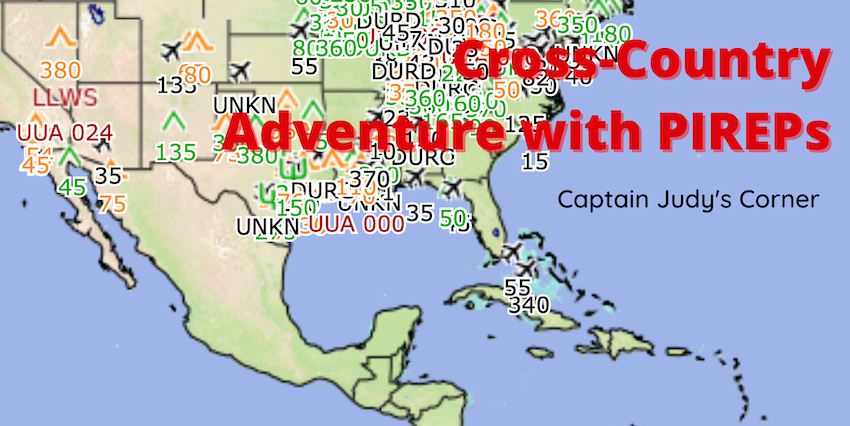
Captain Judy’s Corner: Cross-Country Adventure with PIREPs Sunrise brings the promise of perfect flying weather! Today is a satisfying day to apply your knowledge to practice with the long solo cross-country. Therefore, your private pilot check ride prep will follow.  You arrive at Epic Flight Academy obtaining a final review on weather before departure. There are ample computers in the flight planning area connected to Aviation Weather. The METeorogical Aerodrome Report (METAR), Terminal Aerodrome Forecast (TAF), graphic weather, radar and satellite imaging, prognostic charts all indicate departure, enroute weather, and destination are visual flight rules (VFR). There are currently no pilot reports, also called PIREPs, along your route. A call to 800-WX-BRIEF Flight Service Station (FSS) briefer verified the VFR online … Read more

Captain Judy’s Corner: One Flight Student’s Recipe for Success in Dealing with an FAA Medical Deferral

Appealing an FAA Medical Deferral

In this article, Captain Judy Rice spotlights Epic flight student Bryce Dawson‘s recipe for success in navigating challenges with his FAA medical deferral. Captain Judy interviewed Bryce for this inspirational article about one student’s journey to become a pilot. Combine the following ingredients and adjust for best results: Background December 23,1997, Paul Dawson, risk insurance agent, and Paula Dawson, public school teacher, welcomed their firstborn and named him Bryce. Brother Connor came along 23 months later.  The Dawsons raised their children with their same high standards for work ethic, determination, and professionalism. The children knew only these standards. Bryce shared, “My parents were always patience and supportive. Looking back, I now realize that we matured at a younger age.” When the brothers were … Read more

Recipe for Success: How to Study to Become a Pilot

How to Study to Become a Pilot

Coordinating my hands and feet while manipulating the flight controls, rudder pedals, and at the same time focusing on flying the airplane was a big challenge. Forty years of life experiences had not prepared me for the intense focus and dexterity required while learning to fly.  My first training airplane was a tired Cessna 150 with basic analog instruments. In fact, we navigated with a magnetic compass and heading indicator. The communication radio was an old tube-style with a hand-held microphone. Headsets were not an option. The instructor had to yell guidance over the loud engine noise.  Math was not my strength. Cross-country flying was a nightmare. I was alway lost as check points, headings, altitudes eluded me. I was … Read more

Pilots as Mechanics: Should You Become Both?

Pilots as A&P Mechanics

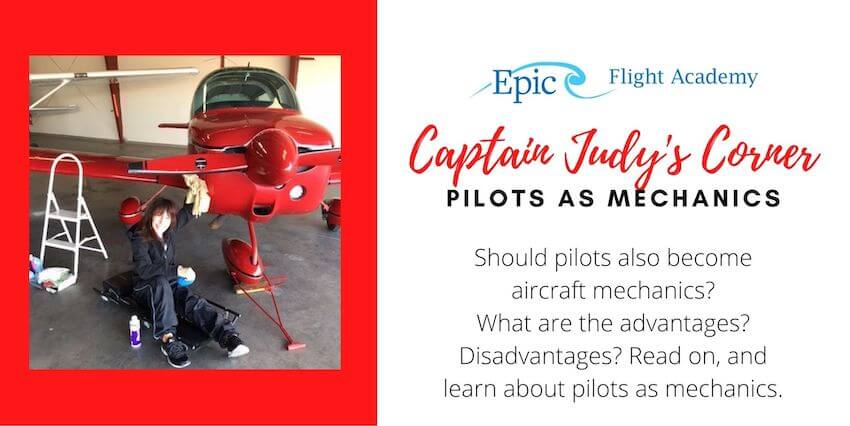
Becoming an aircraft mechanic is a rewarding career. So is becoming a pilot. So, why would anyone go to the trouble of becoming both? After all, you’ll likely choose one or the other for a career. There are many good reasons why people choose to train in both fields. For example, a professional pilot who has become trained as an aircraft mechanic is more likely to notice if something seems ‘off’ during flight. This is a safety issue. Just as an auto mechanic would notice a problem while driving, an A&P would notice a problem with flying. Likewise, a professional mechanic who is also a pilot knows exactly how the controls should feel or how the engine should sound. The … Read more

Epic Chat Close

Loading...

Close